
10 are Better Than One: Will Healthcare Believe the Math?
On the homepage of HIMSS.org is the following image. For some, it’s an illustration of innovation that’s making its way into healthcare. For others it’s a discussion point about whether mobile technology, in its current form, makes sense for busy clinicians, medical scribes and other health care professionals. Literally, it shows a doctor using a single finger to manipulate a tablet. Perhaps all he needs is a single finger to navigate an app, but as many industries have already figured out, when it comes to getting real work done, 10 fingers are always better than one.
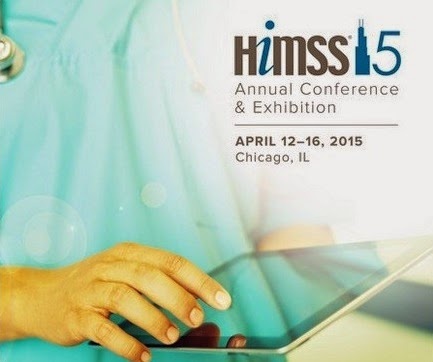
A 2014 headline reads, “Tablets: Not mobile enough or productive enough for many professionals.” The author suggested that one of the main reasons is the lack of a physical keyboard. Here we are in 2015, and not much has changed.
Hospitals and medical practices across the country are investing in mobile technology to handle a variety of administrative tasks, such as accessing patient records, scheduling appointments, and checking patients in and out.
Early concerns included security and data integration, but as these concerns have been overcome, the one challenge that continues to linger is the user experience. Checking records, swiping from screen to screen, and selecting from menu options are easy, but when it comes to data entry, tablets fall short due to the lack of a keyboard.
Keyboards and Productivity Matter
We know that productivity matters to healthcare providers and doctors. However, in this era of electronic healthcare records, there has been a significant increase in documentation, something doctors simply don’t have time to do. Doctors want to focus on providing quality patient care and maximizing their time and skills, not typing on a computer.
This demand for documentation has sparked the emergence of the medical scribe industry, which currently boasts 22 companies supporting physicians in 44 states. The American College of Medical Scribe Specialists estimates that there will be 100,000 scribes by 2020, more than five times the number today.
The laptop, which many scribes carry, has long been considered the best productivity tool for mobile workers. It allows users to take the full keyboard with them, so they can type productively wherever they work. Unfortunately, the laptop is not a mobile solution.
The user still has to sit down and set up to actually be productive with it. In addition, many medical offices were not designed to have extra carts and people in the examination rooms, leaving medical scribes to stand and type with one finger on their laptops or find any available space to perform data entry.
When the tablet was introduced five years ago, many touted it as the quintessential tool for mobile workers. It’s clear by the image above that many healthcare professionals would agree. But the lack of a physical keyboard has reduced data entry to hunt-and-peck typing with one or two fingers, and resulted in people generally using tablets for data consumption, not for getting work done.
The global proliferation of tablets and smartphones has created a peripheral market that seeks to address this productivity challenge by introducing add-on “portable” keyboards and alternative text-entry apps. It has also created hybrid devices called two-in-ones, which provide an either/or solution to the productivity challenge. While typing on tablets has improved, current devices allow mobile workers to be mobile or productive, but not both.
In Between Laptops and Tablets
The answer to this mobile productivity challenge lies somewhere in between laptops and tablets, and it still includes a physical keyboard. It’s the reason why TREWGrip introduced the TREWGrip Mobile Dock, a handheld keyboard and air mouse for today’s mobile technology, smart TVs, and desktop computers.
The ubiquitous QWERTY keyboard is split and rotated so clinicians and medical scribes can hold TREWGrip and perform 10-finger text entry in any environment while using a variety of technology platforms.
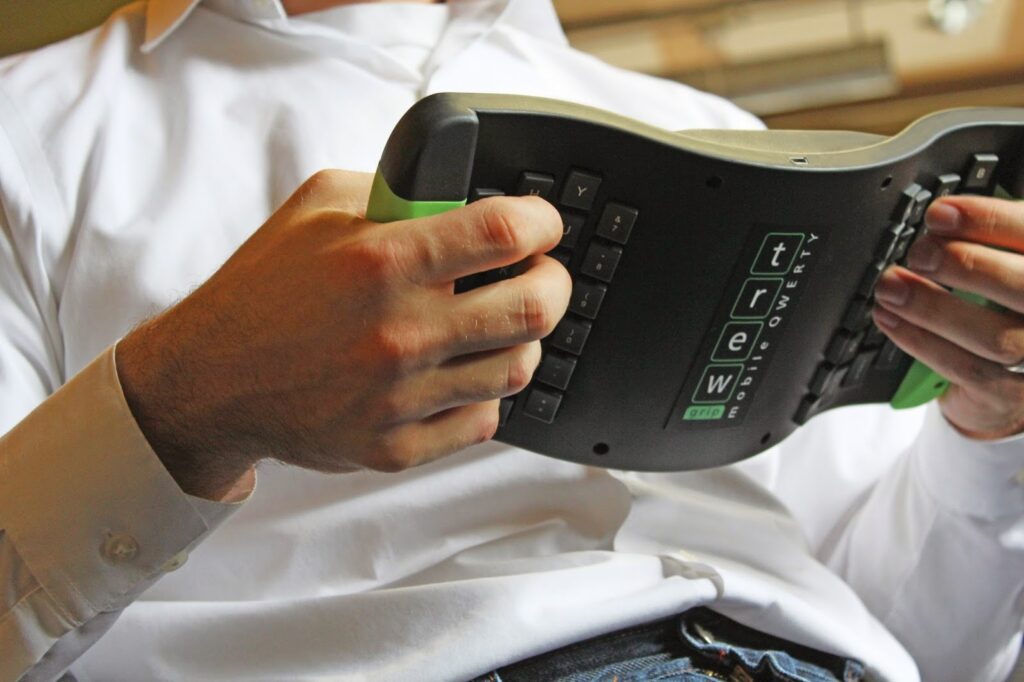
The demand for more documentation of patient information and managing patient orders requires more than a click, a swipe, or a tap. Doctors know it, and as a result, many have backed away from computers and brought in medical scribes who use portable solutions in environments that demand mobility.
Healthcare professionals need technology that offers convenience and flexibility, enabling them to be effective and productive while standing, sitting, or moving from the examination room to the office. Most importantly, they need to be able to use both hands, because ultimately, 10 fingers are the secret to getting real work done.